
What is a Visual language?

Visual language is everywhere, making communication faster and deeper. The key takeaway: visual language helps you understand and connect with ideas quickly and memorably.
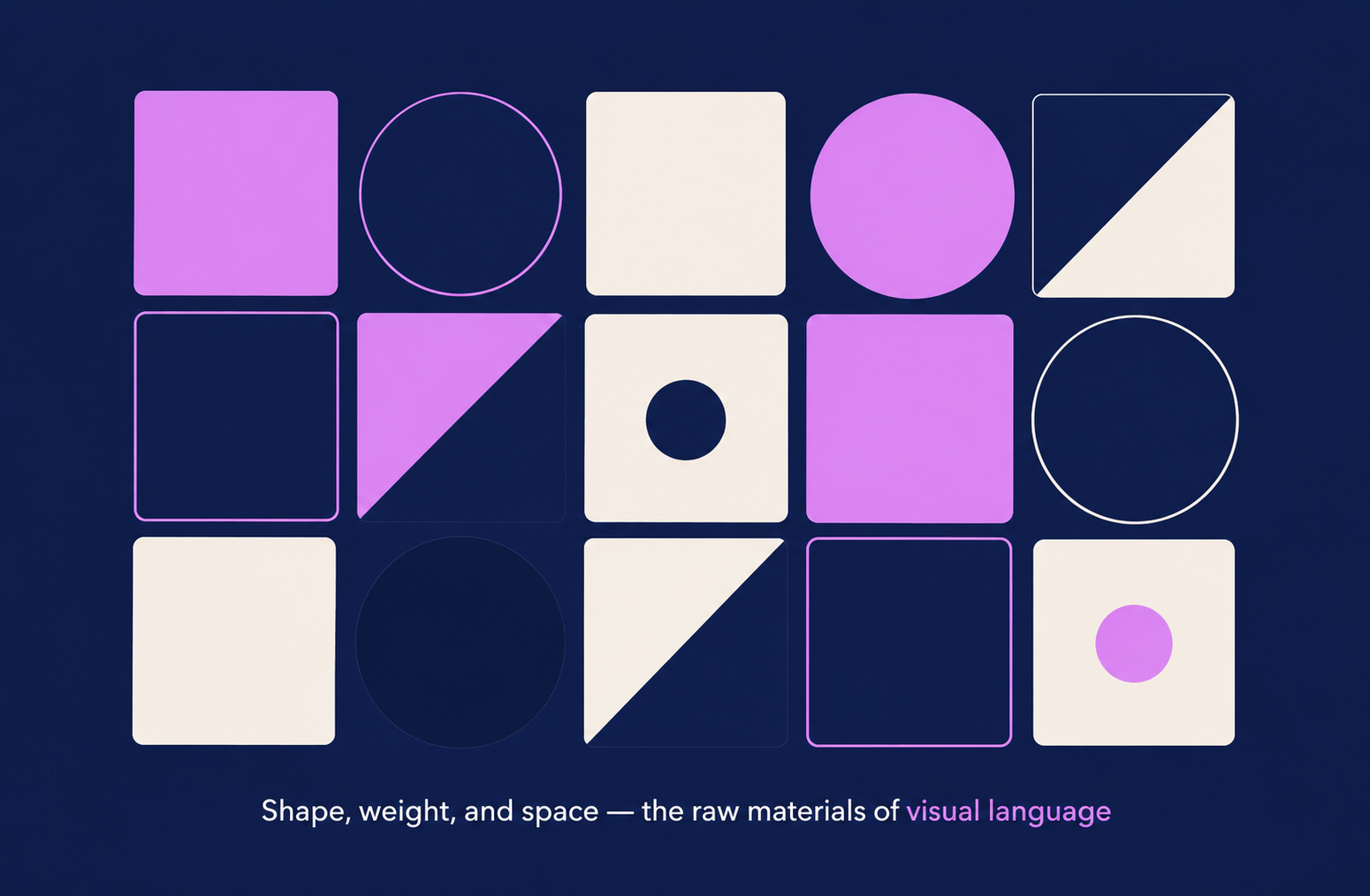
Picture landing in a country whose language you've never heard. Within minutes, you know which door is the exit, which tap is hot, and where you're not allowed to go. No translation needed.
Visual language is a structured system of visual elements that conveys meaning quickly. Key takeaway: it functions like spoken language, but delivers clarity at speed.
The Elements
Every visual language is built from a handful of basic building blocks. These aren't arbitrary; they map onto the ways human perception naturally works.
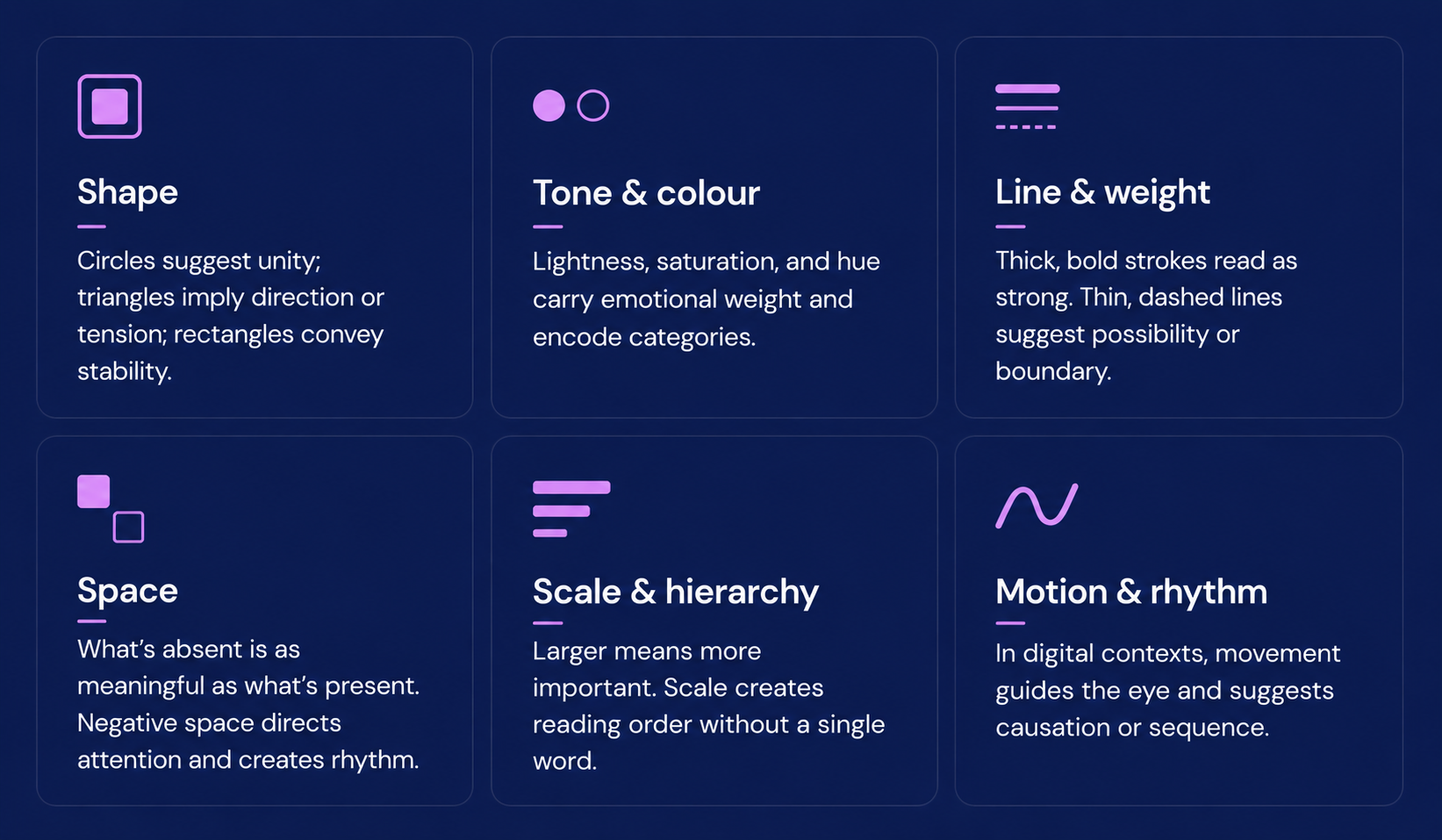
These elements don't operate in isolation. Like words in a sentence, their meaning emerges from how they are arranged in relation to each other. A red circle means one thing on a traffic light and something entirely different on a dashboard.
"Visual language is not decoration applied to information. It is the information."
Grammar: How Elements Relate
In spoken language, grammar tells you who did what to whom. In visual language, grammar handles similar questions: which thing is most important? How are these elements related? What comes first?
Proximity groups things together. Elements that are close to each other are perceived as belonging to the same category or concept, a principle so deeply wired into human perception that designers rely on it without thinking. Alignment creates implied lines that organise a composition and guide the eye. Repetition builds consistency and trust; if the same visual pattern always signals the same meaning, viewers learn without a word of instruction needed.
Contrast does the heavy lifting of hierarchy. By making one element dramatically different from everything around it, darker, larger, more saturated, the designer all but stamps an invisible sign reading "start here." This is why a single bold headline on a white page can stop a scrolling reader cold.
In our work, across data dashboards, infographics, interactive reports, and visual systems, these grammar rules are the invisible scaffolding that makes complex information feel navigable. When they're applied well, the audience doesn't notice them. They simply understand.
Context: the third dimension
The most effective visual languages are built with their audience explicitly in mind. To clarify: medical diagrams use conventions clinicians expect; financial charts follow norms traders rapidly understand; brand identities assemble signs that signal values to specific cultural communities. In each case, vocabulary and grammar are chosen to resonate with a group's shared knowledge. The key takeaway is that every visual language is intentionally shaped to help a specific audience comprehend information quickly and accurately.
A spectrum of visual languages
Visual language exists on a spectrum. Key takeaway: from universal systems to personal expressions, visual language adapts to each context.
At the codified end sit systems like road signs and scientific notation: strict, standardised, intentionally free of ambiguity. At the expressive end sits fine art, where "rules" are often broken and ambiguity is the point. Between lies a vast middle ground: brand identity, data visualisation, interface design, editorial illustration, each with its own evolving conventions.
Why it matters
We navigate dashboards, interpret reports, read maps, and decode data every day, often without realising it. Organisations that understand visual language communicate clearly and build stronger relationships—trust comes faster, decision friction decreases, and audiences return.
Clarity is always the goal. Key takeaway: visual language moves audiences from confusion to understanding and action, making information meaningful.
Visual language is our birthright and a powerful tool. Key takeaway: it is fundamental to human connection and understanding, refined over millennia.
We shine a light on complex ideas—making clarity and understanding possible for everyone.

Your information deserves not just to be seen, but to be understood, and acted upon.
If your data, reports, or ideas aren’t connecting, it’s not the content—it’s the language. Let us help make your message clear and actionable.